Improving the Resilence of Azure VM Disk

In Microsoft Azure there are many features available to improve the resilience of your Azure resources. In this article, I am going to focus on the resilience of an Azure VM Disk.

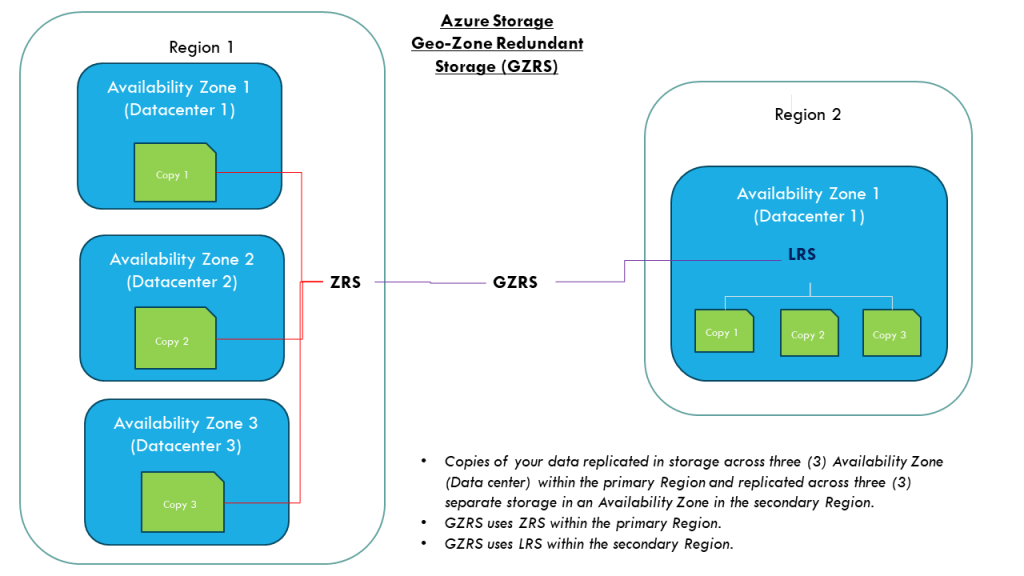
Let me paint a scenario where a Azure VM was created with a disk as LRS (locally redundant storage). The risk with the LRS is the disks are only protected against physical failures within a single datacenter such as server rack or drive failure. However, to increase the resilience of the VM disk against datacenter failures, I recommend that it is configure as ZRS (zone-redundant storage).

To convert a disk from LRS to ZRS, the correct procedure must be followed based on whether the disk is zonal or regional. To check this state, run the following command:

Azure CLI:

az disk show –name [DiskName] –resource-group [RGName]

If the zone parameter is empty, it is an indication that it is regional otherwise it is zonal.

The disk locality will be determine which method is applied to convert the disk from LRS to ZRS. Once verified as regional continue to the next steps to start the process.

For regional disk, it is necessary to only deallocate(shutdown) the Azure VM and then convert the disk using the commands:

Firstly, gather the Azure VM and disk information and create variables to store these values:

$RGName='ResourceGroupName'

$vmDiskName='VMDiskName'

$vmSize='Standard_DS_v2'

$diskSKU='Premium_ZRS'

Get the Parent VM Id (required for sizing of the VM if disk type is changed from Premium to Standard)

$vmId= $(az disk show \

–name$vmDiskName \

–resource-group $RGName \

–query manageBy \

–output tsv)

Stop the Azure VM in preparation for disk conversion

az vm deallocate --ids $vmId

Upgrade the Azure VM size (this step is critical that VM size can support the disk SKU or the disk conversion may fail)

az vm resize –ids $vmId –size $vmSize

Convert the disk from LRS to ZRS:

az disk update –name $vmDiskName –sku $diskSKU –resource-group $RGName

Start up the VM:

az vm start –ids $vmId

If the disk is zonal:

  • a snapshot of the original disk will need to be created.
  • Then a new disk will be created from the snapshot.
  • when the disk is created, a new VM will be provisioned with this new disk atached.

I hope this article assist with the steps to convert a disk from LRS to ZRS.

Reference:

Disk Migration LRS to ZRS

Multi-Cloud Architect Study Guide and Resources

Introduction

I have created this article to reflect the title which is to provide study resources to prepare for the various Cloud Architect certifications for Oracle, Google Cloud, Amazon Web Services and Microsoft Azure. Each of them brings their own dynamics to the architecture space and has difference focus and value. When you combine the information together, it will make you a well rounded Architect. The only missing piece is the business side because these resources only bring the technology perspective and focus. To fill this gap, I have included other resources from my references who I believe are enlightening the technical community on how to approach Architects with soft skills which is more important than the technical skills (the know how). Resources are from difference sources:

Technical Skills for Cloud Architects from different Cloud Service Providers:

Oracle Cloud Infrastructure 2023 Architect Associate

Oracle Cloud Infrastructure 2023 Architect Professional

Google Cloud Professional Cloud Architect

AWS Solutions Architect Professional

Azure Solutions Architect Expert

Microsoft Certification Learning Resources

This article was created for me to keep track of the Microsoft Learning resources available to acquire the knowledge needed to prepare for the Microsoft Certifications.

The material includes preparation for following certifications:

  • AZ-900
  • AZ-104
  • AZ-800/AZ-801
  • AZ-500
  • AZ-700
  • AZ-305
  • AZ-400
  • AZ-140
  • SC-300
  • MS-900
  • MS-500 (expires June 30, 2023)
  • MS-100/ MS-101 (expires July 31, 2023) / MS-102
  • AI-900
  • AI-102
  • DP-900
  • DP-420
  • DP-300

Microsoft Learn
https://learn.microsoft.com/en-us/

Microsoft Learning Lab Exercises
https://github.com/MicrosoftLearning

Microsoft Azure Connected Learning Experience (CLX)
https://clx.cloudevents.ai/events/39366311-ad15-4b90-9364-0252213842fa

Microsoft Partner Training
https://partner.microsoft.com/en-us/training/training-events

MS365 Lab Resources for Microsoft Partner
https://transform.microsoft.com/modernwork/partner

Microsoft Learn Lab Exercise
https://microsoftlearning.github.io/AZ500-AzureSecurityTechnologies/
https://microsoftlearning.github.io/MS-500-Microsoft-365-Security/
https://microsoftlearning.github.io/SC-300-Identity-and-Access-Administrator/
https://microsoftlearning.github.io/AZ-104-MicrosoftAzureAdministrator/

https://microsoftlearning.github.io/AZ-305-DesigningMicrosoftAzureInfrastructureSolutions/

https://microsoftcloudworkshop.com/

https://microsoftlearning.github.io/AZ500-AzureSecurityTechnologies/

https://microsoftlearning.github.io/AZ-140-Configuring-and-Operating-Microsoft-Azure-Virtual-Desktop/

https://microsoftlearning.github.io/AZ400-DesigningandImplementingMicrosoftDevOpsSolutions/

Microsoft Simulation Guide

https://mslearn.cloudguides.com/en-us/guides/AZ-900%20Exam%20Guide%20-%20Azure%20Fundamentals
https://mslabs.cloudguides.com/guides/DP-900%20Exam%20Guide%20-%20Azure%20Data%20Fundamentals
https://mslabs.cloudguides.com/guides/AI-900%20Exam%20Guide%20-%20Azure%20AI%20Fundamentals

https://mslabs.cloudguides.com/guides/AZ-104%20Exam%20Guide%20-%20Microsoft%20Azure%20Administrator

https://mslabs.cloudguides.com/guides/AZ-700%20Lab%20Simulations%20-%20Designing%20and%20implementing%20Microsoft%20Azure%20networking%20solutions

https://mslabs.cloudguides.com/guides/AZ-800%20Lab%20Simulations%20-%20Administering%20Windows%20Server%20Hybrid%20Core%20Infrastructure

https://mslabs.cloudguides.com/guides/AZ-801%20Lab%20Simulations%20-%20Configuring%20Windows%20Server%20Hybrid%20Advanced%20Services

https://mslabs.cloudguides.com/guides/DP-300%20Lab%20Simulations%20-%20Administering%20Microsoft%20Azure%20SQL%20solutions

https://mslabs.cloudguides.com/guides/AI-102%20Lab%20Simulations%20-%20Designing%20and%20implementing%20a%20Microsoft%20Azure%20AI%20solution

https://mslabs.cloudguides.com/guides/DP-420%20Lab%20Simulations%20-%20Designing%20and%20implementing%20cloud-native%20applications%20using%20Microsoft%20Azure%20Cosmos%20DB

Third party resources:

John Savill – https://learn.onboardtoazure.com/

Susanth Sutheesh – https://www.aguidetocloud.com/

Microsoft Azure Paid Labs environment and Training – ACloudGuru.com

I will update this list as times progresses and the information changes.

Disclaimer: all information is provided as is and if there are any changes Microsoft website is the ultimate authority and the respective producers.

AZ-305 – Microsoft Azure Solution Architect Study Resources

I wanted to share the resources that I used to prepare for the AZ-305 Microsoft Certified: Azure Solutions Architect Expert.

  1. Microsoft Learn
  2. AZ-305 Microsoft Learn Case Study
  3. Thomas Maurer AZ-305 Study Guide
  4. Microsoft Cloud Workshop
  5. Microsoft AZ-305 Official Exam Prep
  6. John Savill’s AZ-305 Video Study Playlist

I will update this list as I gather more resources.

Connecting a Web App Service to a Azure VM privately

This article is about setting a public accessible Web App Service which allowing it to connect privately to a Azure VM within a Virtual network (VNET).

I was given a task to assist our developer to connect a Web App with customized code to interface with a Azure VM hosting an SQL server database and customized web services. The design requirements were as followings:

  • The Web App must be accessible public with no restrictions
  • The Azure VM must be accessible by the Web App Service only
  • The services must use most cost effective Azure resources to accomplish this result.

After reviewing the requirements and accessing what Azure features are available to accomplish the task. The following solution was provided.

  1. The Web App Service must have the supported pricing tier of at least Basic or Standard to use it with VNet.
  2. Configure a Subnet with CIDR notation of /26 which will facilitate the private connection from the Web App.
  3. Configure the VNET Integration to connect the Web App to the subnet created previously for the private communication.
  4. Network Security Group (NSG) can be used to limit who can accept connections from the Web App service in the private subnet.

Microsoft Documentation reference:

https://learn.microsoft.com/en-us/azure/app-service/configure-vnet-integration-enable

AZ-104 – Microsoft Azure Administrator : Managing Identities and Governance- Manage Azure Active Directory (Azure AD) objects

This article will show the configuration commands required to complete the objectives on the exam guide for the AZ-104. The article information is updated as I complete the respective tasks.

Manage Azure Active Directory (Azure AD) objects

  • Create users and groups

Azure CLI

# Create user

az ad user create –display-name “Full Name” –user-principal-name “Firstname.lastname@domain.com”

# Create user group

az ad group create –display-name “Group Name” –mail-nickname “GroupName”

PowerShell

# Create user

New-AzADuser -DisplayName “Full Name” -UserPrincipalName “Firstname.lastname@domain.com” -MailNickName “FullName”

#Create Group

New-AzADGroup -DisplayName “Group Name” -MailNickName “Groupname”

  • Create administrative units

Azure CLI

# Comment

az noun verb –name variable

PowerShell

# Create a Administrative Unit

New-AzureADMSAdministrativeUnit -DisplayName “NameOfAdminUnit” -Descrption “DescriptionOfAdminUnit”

# Remove a Administrative Unit

Remove-AzureADMSAdministrativeUnit –

  • Manage user and group properties

Azure CLI

# Comment

az noun verb –name variable

PowerShell

# Comment

Verb-Noun -Parameters variable

  • Perform bulk user updates

Azure CLI

# Comment

az noun verb –name variable

PowerShell

# Comment

Verb-Noun -Parameters variable

  • Manage device settings

Azure CLI

# Comment

az noun verb –name variable

PowerShell

# Comment

Verb-Noun -Parameters variable

  • configure Azure AD join

Azure CLI

# Comment

az noun verb –name variable

PowerShell

# Comment

Verb-Noun -Parameters variable

  • Configure self-services password reset

Azure CLI

# Comment

az noun verb –name variable

PowerShell

# Comment

Verb-Noun -Parameters variable
AZ-104 – Microsoft Azure Administrator : Manage Azure Identities and Governance – Manage Role-based access control (RBAC)

This article will show the configuration commands required to complete the objectives on the exam guide for the AZ-104. The article information is updated as I complete the respective tasks.

Manage Role-based Access Control (RBAC)

  • Create a custom role

Azure CLI

# Comment

az noun verb –name variable

PowerShell

# Comment

Verb-Noun -Parameters variable

  • Provide access to Azure resources by assigning roles at different scopes

Azure CLI

# Assigning role Owner to subscription scope

az role assignment create \

–assignee “rbacuser@domain.com” \

–role “Owner” \

— scope “scope_name_or_id”

#Assign role Contributor to resource level

az role assignment create \

–assignee “user@domain.com” \

–scope “/subscriptions/[subid]/resourceGroups/[rgid]/provider/Microsoft.Compute/virtualMachines/[myVM1” \

–role “Contributor”

#Delete role assignment

az role assignment delete \

–assignee “deleteuser@domain.com” \

–scope “scope_name_or_id” \

–role “Owner”

#view all role assignment

az role assignment list –all

PowerShell

# Assigned Owner role at scope level

New -AzRoleAssignment -SignInName “rbacuser@domain.com” `

-RoleDefinitionName “Owner” -scope “scope_name_or_id”

#Delete role assignment

Remove-RoleAssignment -SignInName “user@domain.com” `

-Scope “scope_name_or_id” `

-RoleDefinitionName “Reader”

#List all the Role assignment

Get-AzRoleAssignment

  • Interpret access assignments

Azure CLI

# Comment

az noun verb –name variable

PowerShell

# Comment

Verb-Noun -Parameters variable

AZ-104 – Microsoft Azure Administrator : Deploy and manage Azure compute resources – Create and configure Azure App Service

This article will show the configuration commands required to complete the objectives on the exam guide for the AZ-104. The article information is updated as I complete the respective tasks.

Create and configure Azure App Service

Azure CLI

# Replace the following URL with a public GitHub repo URL

gitrepo=https://github.com/Azure-Samples/php-docs-hello-world webappname=mywebapp$RANDOM

# Create a resource group.

az group create –location eastus –name myRG

# Create an App Service plan in `FREE` tier.

az appservice plan create –name $webappname –resource-group myRG –sku FREE

# Create a web app.

az webapp create –name $webappname –resource-group myRG –plan $webappname

# Deploy code from a public GitHub repository.

az webapp deployment source config –name $webappname –resource-group myRG \

–repo-url $gitrepo –branch master –manual-integration

# Copy the result of the following command into a browser to see the web app.

echo http://$webappname.azurewebsites.net

PowerShell

# Replace the following URL with a public GitHub repo URL

$gitrepo=”https://github.com/Azure-Samples/app-service-web-dotnet-get-started.git”

$webappname=”mywebapp$(Get-Random)”

$location=”West Europe”

# Create a resource group.

New-AzResourceGroup -Name myRG -Location $location

# Create an App Service plan in Free tier.

New-AzAppServicePlan -Name $webappname -Location $location -ResourceGroupName myRG `

-Tier Free

# Create a web app.

New-AzWebApp -Name $webappname -Location $location -AppServicePlan $webappname `

-ResourceGroupName myRG

# Configure GitHub deployment from your GitHub repo and deploy once.

$PropertiesObject = @{ repoUrl = “$gitrepo”; branch = “master”; isManualIntegration = “true”; }

Set-AzResource -Properties $PropertiesObject -ResourceGroupName myRG `

-ResourceType Microsoft.Web/sites/sourcecontrols `

-ResourceName $webappname/web -ApiVersion 2015-08-01 -Force

Azure CLI

# Variables

appName=”AppServiceManualScale$random”

location=”WestUS”

# Create a Resource Group

az group create –name myRG –location $location

# Create App Service Plans

az appservice plan create –name AppServiceManualScalePlan –resource-group myRG –location $location –sku B1

# Add a Web App

az webapp create –name $appName –plan AppServiceManualScalePlan –resource-group myRG

# Scale Web App to 2 Workers

az appservice plan update –number-of-workers 2 –name AppServiceManualScalePlan \

–resource-group myRG

PowerShell

# Comment

# Generates a Random Value

$Random=(New-Guid).ToString().Substring(0,8)

# Variables

$RG=”myResourceGroup$random”

$AppName=”AppServiceManualScale$random”

$Location=”WestUS”

# Create a Resource Group

New-AzResourceGroup -Name $RG -Location $Location

# Create an App Service Plan

New-AzAppservicePlan -Name AppServiceManualScalePlan -ResourceGroupName $RG `

-Location $Location -Tier Basic

# Create a Web App in the App Service Plan

New-AzWebApp -Name $AppName -ResourceGroupName $RG -Location $Location `

-AppServicePlan AppServiceManualScalePlan

# Scale Web App to 2 Workers

Set-AzAppServicePlan -NumberofWorkers 2 -Name AppServiceManualScalePlan `

-ResourceGroupName $RG

Azure CLI

# Comment

az noun verb –name variable

PowerShell

# Comment

Verb-Noun -Parameters variable

Azure CLI

# Comment

az noun verb –name variable

PowerShell

# Comment

Verb-Noun -Parameters variable

  • Configure custome domain names

Azure CLI

# Variable

fqdn=<Replace with www.{yourdomain}>

webappname=mywebapp$RANDOM

# Create a resource group.

az group create –location westeurope –name myResourceGroup

# Create an App Service plan in SHARED tier (minimum required by custom domains).

az appservice plan create –name $webappname \

–resource-group myResourceGroup –sku SHARED

# Create a web app.

az webapp create –name $webappname –resource-group myResourceGroup \

–plan $webappname

echo “Configure a CNAME record that maps $fqdn to $webappname.azurewebsites.net” read -p “Press [Enter] key when ready …”

# Before continuing, go to your DNS configuration UI for your custom domain and follow the

# instructions at https://aka.ms/appservicecustomdns to configure a CNAME record for the

# hostname “www” and point it your web app’s default domain name.

# Map your prepared custom domain name to the web app.

az webapp config hostname add –webapp-name $webappname \

–resource-group myResourceGroup \

–hostname $fqdn

echo “You can now browse to http://$fqdn&#8221;

PowerShell

# Variable

$fqdn=”<Replace with your custom domain name>”

$webappname=”mywebapp$(Get-Random)”

$location=”West Europe”

# Create a resource group.

New-AzResourceGroup -Name $webappname -Location $location

# Create an App Service plan in Free tier.

New-AzAppServicePlan -Name $webappname -Location $location `

-ResourceGroupName $webappname -Tier Free

# Create a web app.

New-AzWebApp -Name $webappname -Location $location -AppServicePlan $webappname `

-ResourceGroupName $webappname

Write-Host “Configure a CNAME record that maps $fqdn to $webappname.azurewebsites.net” Read-Host “Press [Enter] key when ready …”

# Before continuing, go to your DNS configuration UI for your custom domain and follow the

# instructions at https://aka.ms/appservicecustomdns to configure a CNAME record for the

# hostname “www” and point it your web app’s default domain name.

# Upgrade App Service plan to Shared tier (minimum required by custom domains)

Set-AzAppServicePlan -Name $webappname -ResourceGroupName $webappname `

-Tier Shared

# Add a custom domain name to the web app.

Set-AzWebApp -Name $webappname -ResourceGroupName $webappname `

-HostNames @($fqdn,”$webappname.azurewebsites.net”)

The offline backup is a full backup each time and not an incremental copy.

Azure CLI

#

groupname=”myResourceGroup”

planname=”myAppServicePlan”

webappname=mywebapp$RANDOM

storagename=mywebappstorage$RANDOM

location=”WestEurope”

container=”appbackup”

backupname=”backup1″

expirydate=$(date -I -d “$(date) + 1 month”)

# Create a Resource Group

az group create –name $groupname –location $location

# Create a Storage Account

az storage account create –name $storagename \

–resource-group $groupname –location $location \

–sku Standard_LRS

# Create a storage container

az storage container create –account-name $storagename –name $container

# Generates an SAS token for the storage container, valid for one month.

# NOTE: You can use the same SAS token to make backups in App Service until –expiry sastoken=$(az storage container generate-sas –account-name $storagename –name $container \ –expiry $expirydate –permissions rwdl –output tsv)

# Construct the SAS URL for the container sasurl=https://$storagename.blob.core.windows.net/$container?$sastoken

# Create an App Service plan in Standard tier. Standard tier allows one backup per day.

az appservice plan create –name $planname –resource-group $groupname –location $location \

–sku S1

# Create a web app

az webapp create –name $webappname –plan $planname –resource-group $groupname

# Create a one-time backup

az webapp config backup create –resource-group $groupname –webapp-name $webappname \

–backup-name $backupname –container-url $sasurl

# List statuses of all backups that are complete or currently executing.

az webapp config backup list –resource-group $groupname –webapp-name $webappname

PowerShell

# Variables

$webappname=”mywebapp$(Get-Random -Minimum 100000 -Maximum 999999)” $storagename=”$($webappname)storage”

$container=”appbackup”

$location=”West Europe”

$backupname=”backup1″

# Create a resource group.

New-AzResourceGroup -Name myResourceGroup -Location $location

# Create a storage account.

$storage = New-AzStorageAccount -ResourceGroupName myResourceGroup `

-Name $storagename -SkuName Standard_LRS -Location $location

# Create a storage container.

New-AzStorageContainer -Name $container -Context $storage.Context

# Generates an SAS token for the storage container, valid for one month.

# NOTE: You can use the same SAS token to make backups in Web Apps until -ExpiryTime

$sasUrl = New-AzStorageContainerSASToken -Name $container -Permission rwdl `

-Context $storage.Context -ExpiryTime (Get-Date).AddMonths(1) -FullUri

# Create an App Service plan in Standard tier. Standard tier allows one backup per day.

New-AzAppServicePlan -ResourceGroupName myResourceGroup -Name $webappname `

-Location $location -Tier Standard

# Create a web app.

New-AzWebApp -ResourceGroupName myResourceGroup -Name $webappname ` -Location $location -AppServicePlan $webappname

# Create a one-time backup

New-AzWebAppBackup -ResourceGroupName myResourceGroup -Name $webappname `

-StorageAccountUrl $sasUrl -BackupName $backupname

# List statuses of all backups that are complete or currently executing.

Get-AzWebAppBackupList -ResourceGroupName myResourceGroup -Name $webappname

  • Configure networking settings

Azure CLI

# Comment

az noun verb –name variable

PowerShell

# Comment

Verb-Noun -Parameters variable

  • Configure deployment settings

Azure CLI

# Comment

az noun verb –name variable

PowerShell

# Comment

Verb-Noun -Parameters variable

AZ-104 – Microsoft Azure Administrator : Deploy and manage Azure Compute resources – Configure VMs

This article will show the configuration commands required to complete the objectives on the exam guide for the AZ-104. The article information is updated as I complete the respective tasks.

Configure VMs

  • Configure Azure Disk Encryption

Azure CLI

# Create a Key Vault

az keyvault create –name myKV –resource-group myRG –location eastus –enabled-for-disk-encryption

# Update Key Vault to allow the storing of disk encryption key

az keyvault update -n myKV -g myRG –enabled-for-disk-encryption

#Encrypt an existing VM disk

az vm encryption enable -n myVM -g myRG –disk-encryption-keyvault myKV –volume-type all

# View the status of Disk encryption

az vm encryption show -n myVM -g myRG

#Decrypt the VM disk

az vm encryption disable -n myVM -g myRG

PowerShell

# Create Azure KeyVault

New-AzKeyVault -VaultName myKV `

-ResourceGroupName myRG `

-Location EastUS `

-EnabledForDiskEncryption

# Change the KeyVault Policy Access

Set-AzKeyVaultAccessPolicy -VaultName myKV -ResourceGroupName myRG `

-EnabledForDiskEncryption

# Encrypt the VM disk

Set-AzVMDiskEncrytpionExtension -VMname myVM -ResourceGroupName myRG `

-VolumeType [All|OS|Data] -DiskEncryptionKeyVaultID myKV.id `

-DiskEncryptionKeyVaultUri myKV.uri -SkipVMBackup

#View the Disk Encryption Status

Get-AzVMDiskEncryptionStatus -VMname myVM -ResourceGroupName myRG

#Decrypt VM disk

Disable-AzVMDiskEncryption -VMname myVM -ResourceGroupName myRG

  • Manage VM sizes

Azure CLI

# Check the VM current size

az vm show –name myVM –resource-group myRG –query hardwareProfile.vmSize

#List the available size to the VM

az vm list-vm-resize-options –resource-group myRG –name myVM

#Resize the VM to the size of choice from the list generate from command

az vm resize –name myVM –resource-group myRG –size Standard_B1s

#Deallocate VM if the size desired is not listed to be made available

az vm deallocate –name myVM –resource-group myRG

az vm stop –name myVM –resource-group myRG

PowerShell

Get-AzVmSize -VMName myVM -ResourceGroupName myRG

$vm = Get-AzVM -VMName myVM -ResourceGroupName myRG

$vm.HardwareProfile.VmSize = “Standard_B1ls”

Update-AzVM -VM $vm -ResourceGroupName myRG

#Deallocate VM

Stop-AzVM -Name myVM -ResourceGroupName myRG

#Only Stop VM but does not deallocate it

Stop-AzVM -Name myVM -ResourceGroupName myRG -StayProvisioned

  • Add Data Disks

Azure CLI

# Create the disk and attached it to the VM in one command

az vm disk attached -g myRG -vm-name myVM –name myDisk –new –size-gb 32 \

–sku Standard_LRS

PowerShell

# Set the data disk configuration

$diskConfig = new-AzDiskConfig -SkuName “Standard_LRS” -Location “EastUS” `

-CreateOption Empty -DiskSizeGB 32

# Create the data disk

$dataDisk1 = new-AzDisk -DiskName myDisk -Disk $diskConfig -ResourceGroupName myRG

# Get the Virtual Machine information

$vm = Get-AzVM -Name myVM -ResourceGroup myRG

# Add the Disk information to VM

$vm = Add-AzVMDataDisk -VM $vm -Name myDisk -CreateOption Attach `

-ManagedDiskId #dataDisk1.Id -Lun 1

#Update the VM with the data disk

Update-AzVM -VM $vm -ResourceGroupName myRG

# The second phase is to intialize the disk within the VM.

  • Redeploy VMs

Azure CLI

# Redeploy a virtual machine

az vm redeploy –name myVM –resource-group myRG

PowerShell

# Redeploy a virtual machine

Set-AzVM -Redeploy -ResourceGroupName “myRG” -Name “myVM”

  • Move Resource to another Resource group

Azure CLI

# Comment

az resource move –destinationresourcegroupname myRG2 –ids myVMid myStorageid

PowerShell

# Move resource to another resource group

$webapp = Get-AzResource -ResourceGroupName myRG -ResourceName mySite

$vm = Get-AzResource -ResourceGroupName myRG -ResourceName myVM

Move-AzResource -DestinationResourceGroupName myRG2 -ResourceId $webapp.ResourceId, $vm.ResourceId

  • Configure Networking

Azure CLI

# Comment

az noun verb –name variable

PowerShell

# Comment

Verb-Noun -Parameters variable

  • Configure High Availability

Azure CLI

# Comment

az noun verb –name variable

PowerShell

# Comment

Verb-Noun -Parameters variable

  • Deploy and configure scale sets

Azure CLI

# Comment

az noun verb –name variable

PowerShell

# Comment

Verb-Noun -Parameters variable