CCNP Route 300-101 – OSPF

This article was written about OSPF as I prepare for the CCNP. It was be updated as I progress.

OSPF is the acronym for Open Shortest Path First which is a vendor mutual routing protocol.

  • Shortest Path First SPF Algorithm for calculating the cost.
  • Default hello timer: 10 seconds
  • Default dead timer: 40 seconds (4 x hello)
  • Multicast address: 224.0.0.5 and 224.0.0.6
  • Communication Protocol:
  • Administrative distance of 110
  • Process ID is local significant and is not required to be the same with the neighbors.
  • The router ID is set using the following method in order:
    • using the router-id command
    • the highest IP address on the active loopback interface
    • The highest IP address on the active physical interface
  • Link State Updates (LSU) send every 30 minutes

OSPF neighbor relationship

OSPF States

Down –> Init –> 2Way –> ExStart –> Exchange –> Loading –> FULL

OSPF Packet Types

Type 1 – Hello

The purpose is to maintain the neighbor relationship using it as a keepalive.

debug ip ospf events of packet type 1debug_hello

Wireshark capture of packet type 1.OSPFType1Hello

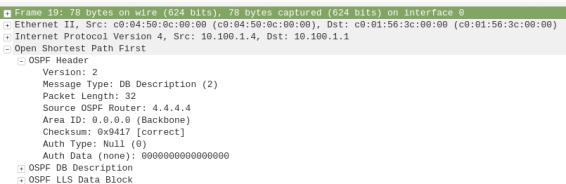
Type 2 – Database Description (DBD)

debug ip ospf events of packet type 2debug_DBD.png

Wireshark capture of packet type 2ospftype2-dbdesc

Type 3 – Link State Request (LSR)

debug ip ospf events of packet type 3debug_LSR

Wireshark capture of packet type 3ospf-type3-LSReq

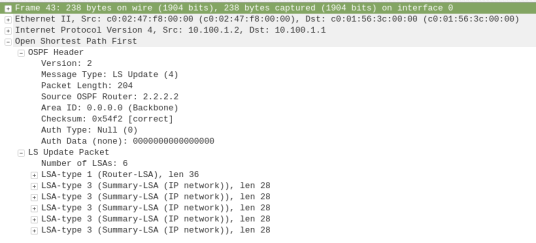
Type 4 – Link State Update (LSU)

debug ip ospf events of packet type 4debug_LSU

Wireshark capture of packet type 4ospf-type4-lsupdate

Type 5 – Link State Acknowledge (LSAck)

debug ip ospf events of packet type 5debug_LSAck

Wireshark capture of packet type 5ospf-type5-lsAck

OSPF Network Types

  • Loopback – Stub Host – /32
  • P2P – Point-to-Point – HDLC
  • Broadcast – FastEthernet – DR/BDR
  • NBMA -Non-Broadcast Multi Access
  • P2MP – Point-to-Multipoint –
  • Virtual Links

OSPF Area and Router Types

ASBR – Autonomous System Border Router

ABR – Area Border Router

Stubby Area

Totally Stubby Area

Not-So Stubby Area

CCNP Route 300-101 – VRF lite

This article is going to take you through the configuration of VRF lite. VRF stands for Virtual Routing/Forwarding which is technology that allows you to have multiple routing tables that are kept isolated on a router. It is a feature similar to VLANs on a switch. VRF lite allows you to use the same subnets for each

You can refer to this Cisco document for further details: https://www.cisco.com/c/en/us/td/docs/switches/lan/catalyst4500/12-2/25ew/configuration/guide/conf/vrf.html#wp1045190

Note that VRF is usually used when configuring MPLS but because we are not using it with MPLS, it is referred to as VRF lite.

Configuration of VRF lite for IPv4

The following steps will be required to successfully configure VRF lite:

  1. Create the VRF and set the route distinguisher (rd)

R1(config)# ip vrf [NAME]

R1(config-vrf)# rd 100:1

2. Assigning the interfaces to the VRF (Note: VRF clears the interface IP address so you will have to reconfigure the ip address after applying this command)

R1(config-if)# ip vrf forwarding [NAME]

Review VRF Configuration

  1. Show the Assigned VRF Interfaces

R1# show ip vrf interfaces

2. Show the VRFs

R1# show ip vrf

3. Show the Routing Table within a VRF

R1# show ip route vrf [NAME]

4. Show the routing protocols operating within VRF

show ip protocol vrf [NAME]

Configure EIGRP and VRF Lite

R1(config)# router eigrp AS

R1(config-router)# address-family ipv4 vrf [NAME] autonomous-system AS

R1(config-router-af)#network [Subnet] [wildcard_mask]

Configure OSPF and VRF Lite

R1(config)# router ospf [Process-id] vrf [NAME]

Configure RIPv2 and VRF Lite

R1(config)# router rip

R1(config-router)# address-family ipv4 vrf [NAME]

Configuration of VRF lite for both IPv4 & IPv6

  1. Create the VRF and set the route distinguisher (rd)

R1(config)# vrf definition [NAME]

R1(config-vrf)# rd 100:1

R1(config-vrf)#address-family [ipv4|ipv6]

2. Assigning the interfaces to the VRF (Note: VRF clears the interface IP address so you will have to reconfigure the ip address after applying this command)

R1(config-if)# ip vrf forwarding [NAME]

Export and Import Routes from one VRF to another

Importing routes from another VRF using the RD (route distinguisher)

R1(config-vrf)# route-import [RD]

Exporting routes from the VRF using the RD (route distinguisher)

R1(config-vrf)# route-export [RD]

example:

ip vrf GREEN

rd 100:1

route-export 100:1234

ip vrf RED

rd 200:1

router-import 100:1234

Set Default VRF Lite Name

This commands allows you to configure the router in the stated VRF mode.

R1#routing-context vrf [VRFNAME]

R1%VRFNAME#


CCNP Route 300-101 – PPPoE

PPPoE is the ability to negotiate a direct PPP link between multiple layer 3 devices
through a layer 2 switched infrastructure. This negotiation then allows the encapsulation of IP packets inside of PPP which is then encapsulated inside an Ethernet frame.

definition reference: https://learningnetwork.cisco.com/docs/DOC-27502

PPPoE Session Process

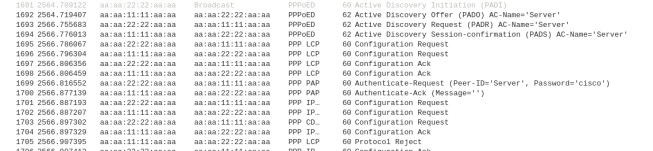
  1. PPPoED Active Discovery Initiation (PADI) – The PPPoE client sends a broadcast
  2. PPPoED Active Discovery Offer (PADO) – The PPPoE server reply with an session offer
  3. PPPoED Active Discovery Request (PADR) – The PPPoE client request to connect to session
  4. PPPoED Active Discovery Session-confirmation (PADS) – The PPPoE server confirms session connection

PPPoED Active Discovery Terminate (PADT) – the session is terminated  by client/server or due to configuration mismatch after it is shared between client and server.

The image below display a wireshark capture of the PPPoE session process mentioned above. Client MAC address contains 1111 and the Server contains 2222.

PPPoE_pcap

Configuring PPPoE Server

1. Configure the virtual template interfaces which allows server to set the configuration template for the each client virtual interface.

R(config)# interface virtual-template 1

R(config-if)# ip address [IP] [Mask]

!Configuring the MTU is necessary so that you don’t have packet fragmentation due to PPP use 2 Bytes and PPPoE uses 6 Bytes of the packet

R(config-if)# mtu 1492

!The peer command is optional if you want to assign an ip address to the clients from a static or DHCP pool

R(config-if)# peer default ip address [pool|dhcp|dhcp-pool] NAME

!The PPP Authentication is optional

R(config-if)# ppp authentication [pap|chap] callin

! After configuring the PAP/CHAP Authentication, you need to configure a username and password

R(config)# username [USER] password [PASSWORD]

2. Configure the Broadband Aggregation (BBA) Group which is used to spawn a virtual interface for each client that dials into the server and assign the virtual template.

R(config)# bba-group pppoe global
R(config-bba-group)#virtual-template 1

3. Configure the physical interface through which the clients will be connecting and assign it the bba group.

R(config)# interface [interface id]

R(config-if)#pppoe enable group global

R(config-if)# no shutdown

Configuring the PPPoE Client

1. Configure the interface Dialer

R(config)# interface Dialer 1

R(config-if)# encapsulation ppp

R(config-if)# ip address

R(config-if)#mtu 1492

R(config-if)#dialer pool 2

!Optional to configure authentication if server requires it

!PAP configuration to send username and password if needed by server

R(config-if ) ppp pap send-uername [USER] password [PASSWORD]

!CHAP configuration to send username(hostname) and password

R(config-f)ppp chap password [PASSWORD]

R(config-f)ppp chap hostname [USER]

2. Associate the physical interface with the dialer on which the PPPoE session will dial out.

R(config)# interface f0/0

R(config-if)# pppoe-client dial-pool-number 2

R(config-if)# no shutdown

Verify and Troubleshoot PPPoE

To verify pppoe is working, use the following commands:

1. Display the PPPoE session – show if the session is established

R# show pppoe session

2. Use debug to show PPPoE Events – displays PADI/PADO/PADR/PADR process

R#debug pppoe events

3. Use debug to show PPP negotiation – displays ppp configuration exchange

R#debug ppp negotiation

This is it for the PPPoE, I hope it helps in knowing how to configure PPPoE.

CCNP Route 300-101 – EIGRP

EIGRP routing protocol for IPv4 and IPv6

  • Default hello messages timer: 5 seconds
  • Default hold-down timer: 15 seconds
  • Multicast address: 224.0.0.10 (IPv4) / FF02::A (IPv6)
  • IP Protocol: 88
  • Administrative distance of 90
  • Autonomous Number is required to be the same with the neighbors.

Basic EIGRP Configuration

!IPv4 EIGRP configuration

R(config)# router eigrp [AS]

R(config)#network [subnet] [wildcard_mask]

!IPv6 EIGRP configuration

R(config)# ipv6 router eigrp 1
R(config-router) eigrp router-id [X.X.X.X]
R(config-router) no shutdown

!Configure command under participating interface in IPv6 EIGRP

R(config-if) ipv6 eigrp [AS]

EIGRP Metrics

To enable to metric for EIGRP, you use the following commands:

R(config-router)# metric weights 0 [K1] [K2] [K3] [K4] [K5]

Where the K values are:

  • K1 – Bandwidth [Kbit/sec] (default 1)
  • K2 –  Load (default 0)
  • K3 – Delay (default 1)
  • K4 and K5 – Reliability (default 0)

Calculating the full Metric (Formula)

Metric = ([K1 * bandwidth + (K2 * Bandwidth) / (256 – Load) + K3 * Delay] * [K5 / (Reliability + K4)]) * 256

Calculating the Default Metric

eigrp_metric_calculation

EIGRP Packets

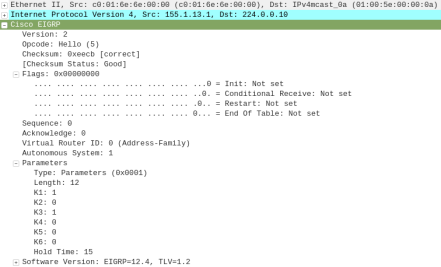
  • Hello (5)

eigrp_hello

  • Update (1)

eigrp_update

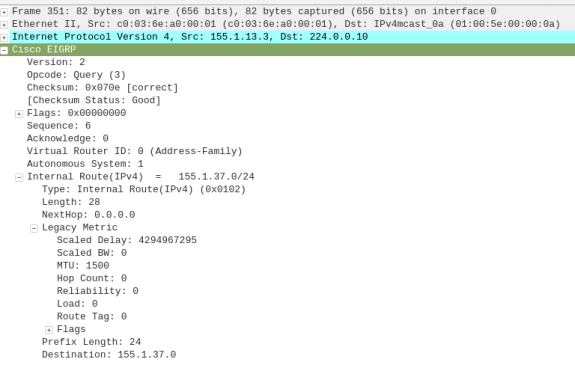
  • Query (3)

eigrp_query

  • Reply (4)

eigrp_reply

  • Ack (5)

eigrp_Hello_Ack

Administrative Distance (AD) – is how far is the router from it’s neighbor.

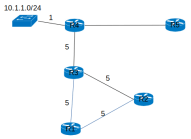
Feasible Distance (FD) – is how far is the router for the destination subnet.eigrp_diagram

  • R1 FD from 10.1.1.0/24 through R3
    • = (R1–>R3) + (R3–>R4) + (subnet 10.1.1.0/24)
    • = 5 + 5 + 1 = 11


Feasible successor – the advertised distance (AD) must be less than the feasible distance (FD) of the Successor (Feasible Successor AD < Successor FD)

EIGRP Neighborship

When the neighbor command is used, it forces the EIGRP to use unicast traffic to discover the neighbor.

R1(config-router)# neighbor [ip address]

The command and out display of the EIGRP neighbor:

show ip eigrp neighbors

show_eigrp_neighbor-cmd

As i continue my studies, this article will be updated.

CCNP Route 300-101 – RIPng

RIPng (RIP next generation) is the routing protocol RIP version for IPv6.

  • Default hello messages timer: 30 seconds
  • Default dead timer: 180 seconds
  • Multicast address: FF02::9
  • Communication Protocol: UDP 521
  • Administrative distance of 120
  • RIP name is not required to be the same with the neighbors.

Configure RIPng on a Router:

  1. Enable IPv6 routing in the global mode

ipv6 unicast-routing

2. Configure RIPng

IPv6 router rip [NAME]

3. Configure interface for IPv6

ipv6 address X:X:X:X::/64 [eui-64]

or

ipv6 enable 

4. Configure interface for RIPng

ipv6 rip [NAME[ enable

output for command: show ipv6 route rip

IPv6 Routing Table – 6 entries
Codes: C – Connected, L – Local, S – Static, R – RIP, B – BGP
U – Per-user Static route, M – MIPv6
I1 – ISIS L1, I2 – ISIS L2, IA – ISIS interarea, IS – ISIS summary
O – OSPF intra, OI – OSPF inter, OE1 – OSPF ext 1, OE2 – OSPF ext 2
ON1 – OSPF NSSA ext 1, ON2 – OSPF NSSA ext 2
D – EIGRP, EX – EIGRP external
R 2222::/64 [120/2]
via FE80::C202:46FF:FED7:0, FastEthernet0/0

output for command: show ipv6 rip

RIP process “WAN”, port 521, multicast-group FF02::9, pid 218
Administrative distance is 120. Maximum paths is 16
Updates every 30 seconds, expire after 180
Holddown lasts 0 seconds, garbage collect after 120
Split horizon is on; poison reverse is off
Default routes are not generated
Periodic updates 207, trigger updates 7
Interfaces:
FastEthernet0/1
FastEthernet0/0
Redistribution:
None

output for command: show ipv6 protocol 

IPv6 Routing Protocol is “rip WAN”
Interfaces:
FastEthernet0/1
FastEthernet0/0
Redistribution:
None

output for command: show ipv6 rip next-hops

RIP process “WAN”, Next Hops
FE80::C202:46FF:FED7:0/FastEthernet0/0 [2 paths]

This article will be updated as I go along.

CCNP Route 300-101 – IPv6 Knowledge

This article is to share the knowledge about IPv6 (Internet Protocol version 6) in a simple way.

The first important knowledge you will needed to know before understanding IPv6 is that it is a 128-bit address that is represented using Hexadecimal values and it will be beneficial to know the binary and decimal equivalent.

Please see below the table showing this information:

Hex Binary Decimal
0 0000 0
1 0001 1
2 0010 2
3 0011 3
4 0100 4
5 0101 5
6 0110 6
7 0111 7
8 1000 8
9 1001 9
A 1010 10
B 1011 11
C 1100 12
D 1101 13
E 1110 14
F 1111 15

The next aspect of IPv6 Addressing to understand is that it is similar to IPv4 address where the address is split up into Octet (10.10.10.1) separated by a dot (.), IPv6 address are split up into quartet (2000:ABCD:0000:0000:0000:0000:0000:0001) separated by a colon (:). Each quartet is made up of 4 Hexadecimal number.

An example of an IPv6 address is below along with the binary of the address:

Quartet Hexadecimal Binary
1st 2000 0010 0000 0000 0000
2nd ABCD 1010 1011 1100 1101
3rd 0000 0000 0000 0000 0000
4th 0000 0000 0000 0000 0000
5th 0000 0000 0000 0000 0000
6th 0000 0000 0000 0000 0000
7th 0000 0000 0000 0000 0000
8th 0001 0000 0000 0000 0001

Shortening the IPv6 Address

there are two methods we can use to shorten the IPv6 address to make it easier to write which is also applied by supported devices.

  1. Eliminating the leading zeros
  2. Using the double colon (::) to represents multiple quartet of zeros. this can only be applied once in an IPv6 address.

let me use an example IPv6 address 2000:ABC0:00ED:0000:0000:1234:0000:0001

Applying shortening rule 1 to eliminating the leading zeros which will be:

2000 : ABC0 : 00ED : 0000 : 0000 : 1234 : 0000 : 0001
2000 : ABC0 : ED : 0 : 0 : 1234 : 0 : 1

Then we are going to apply rule 2 which is to use the double colon (::) to replace multiple quartet of zeros:

2000 : ABC0 : 0 : 0 : 1234 : 0 : 1
2000 : ABC0 :: 1234 : 0 : 1

IPv6 Prefix

The IPv6 address has two main parts to the address:

  1. Prefix (Network ID)
  2. Interface ID (Host ID)

The IPv6 Prefix is denoted by the CIDR /XX. For example 2000::/3 where /3 tells you the network portion of the IPv6 address space.

There are also subdivision of the Prefix:

  1. Registry Prefix – assigned by IANA to an RIR
  2. ISP Prefix – assigned by an RIR to an ISP
  3. Site Prefix (Global Routing Prefix) – assigned by an ISP to customer
  4. Subnet Prefix – assigned by a customer engineer internally

RIR – Regional Internet Registry

IANA – Internet Assigned Numbers Authority

IPv6 Address Types

The unspecified address is an address used by an IPv6 node that has not gotten an IPv6 address.

The Global address is the address space reserved to be routed on the internet which is assigned by the IANA.

The Multicast address is joined by IPv6 nodes depending on the class the device is apart of which will be discussed later.

The Link-local is the address automatically assigned by the IPv6 node using the EUI-64 method once the IPv6 is enabled on an interface.

Types of Address Binary Reality IPv6 method
Unspecified 0000…0 ::/128
Loopback 0000…1 ::1/128
Global 001… (first 3) 2000::/3 (2000 – 3FFF)
Multicast 1111 1111 (first 8) FF00::/8
Link-local 1111 1110 10… (first 10) FE80::/10

There is another special type of address which is the Extended Unique Identifier (EUI-64) that uses the MAC address (48-bit) as part of the IPv6 Address. The challenge with the MAC address is that it is short 16-bit so to make it 64-bit, FFFE will be place in the middle of the MAC address. Another modification that is required to derive the EUI-64 address is that the 7th bit must be flipped. To better understand this address, let me list the rules in a table:

Steps Rule Address
1 Get the Mac Address AAAA.BBBB.CCCC
2 Insert FFFE in the middle of the MAC AAAABB FFFE BBCCCC
3 Flip the 7th bit by converting the first 2 Hex to binary, flipping the 7th bit and then converting it back to Hexidecimal AA = 1010 1010

1010 1000 = A8

A8AA:BB FF:FE BB:CCCC

4 Apply the network prefix. in the example using link-local FE80::/8 FE80:0000:0000:0000:A8AA:BBFF:FEBB:CCCC /64
5 Shorten the IPv6 Address FE80::A8AA:BBFF:FEBB:CCCC /64

Local Multicast Address

IPv6 Local Multicast Address Description
FF02::1 All-node
FF02::2 all-routers
FF02::5 all-OSPF routers
FF02::6 OSPF designated routers
FF02::9 All RIP
FF02::A All-EIGRP
FF02::1:FFxx:xxxx solicited-node where x is the last 6 Hex of the IPv6 unicast address

IPv6 Node Layer 2 Communication

When a IPv6 node needs to communicate at the Layer 2 after receiving a multicast packet, the IPv6 node uses the following Layer 2 (MAC) address format:

3333 : xxxx : xxx1

where X is the last 8 Hex of the MAC address but the 8th Hex is change to 1 as shown above.

For the solicited address after the 3333, we will insert FF and then add the last 6 Hex as shown below:

3333 : FFxx : xxxx

IPv6 Address Dynamic Assignment

Stateless Address Auto Configuration (SLAAC)

  • The IPv6 address is derived using the Network prefix and adding the MAC address to it (EUI-64)
  • It used the Stateless DHCP
  • The prefix must be /64
  • There should be no DHCP IP pool configured on router

Stateful DHCP

  • The IPv6 address is dynamically assigned to the host by the DHCP server along with DNS and gateway.

Domain Name System (DNS) – RF6106

IPv6 Neighbor Discovery Protocol (NDP)

Network Discovery Protocol is defined in the RF 4861.

NDP Message Types

  • Router Solicitation (ICMPv6 type 133)
    • Asking router for information
  • Router Advertisement (ICMPv6 type 134)
    • Router responding with information
  • Neighbor Solicitation (ICMPv6 type 135)
    • Asking the neighbor for information
  • Neighbor Advertisement (ICMPv6 type 136)
    • Neighbor responding with information
  • Redirect (ICMPv6 type 137)
    • redirect of a packet

Function of NDP

  • Duplicate Address Detection (DAD)
  • Router Discovery
  • Address Configuration
  • L2 (link-level) Resolution
  • Redirection of a Packet