CCNP Route 300-101 – SNMP

SNMP stands for Simple Network Management Protocol which is uses to manage your network devices by a management host.

There are three versions of SNMP:

  • SNMPv1
  • SNMPv2c
  • SNMPv3

SNMPv1 and SNMPv2c uses community-string as password which is sent in clear text.

On the other hand, SNMPv3 is able to provide both authentication and encryption to secure the communication. SNMPv3 uses users and groups to grant access which is applied using one of the three security levels.

The SNMPv3 Security Levels:

  • noAuthPriv (noauth)- provides no Authentication or Privacy (encryption)
  • AuthNoPriv (auth) – provides Authentication but no Privacy (encryption)
  • AuthPriv (priv) – provides Authentication and Privacy (encryption)

The authentication supports two algorithms: MD5 and SHA1, while encryption supports algorithms DES, 3DES and AES.

 Configuring SNMPv3

1. Configure the View

snmp-server view [VIEWNAME] iso included

2. Configure the Group

snmp-server group [GROUPNAME] v3 [noauth|auth|priv] [read RName] [write WName] [context CName] [notify NName] [access ACL]

3. Configure the User

snmp-server user [Username] [GroupName] v3 [encrypt] auth [md5|sha] [AuthPWD] priv [des|3des|aes] [PrivPassword] [access ACL]

4. Configure Traps

snmp-server host [IP] traps version [1|2|3] [noauth|auth|priv] [USER] [other_snmp_options]

Verify SNMPv3

show snmp user

snmpuser

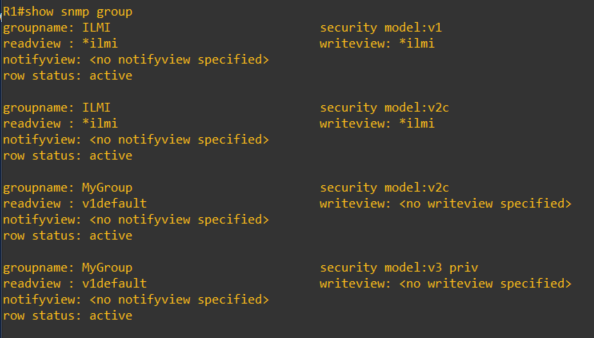
show snmp group

snmpgroup

This article covers some of the SNMP options and configuration of which I am covering in my CCNP studies. For further details, you can visit the Cisco documentations here.

CCNP Route 300-101 – PPPoE

PPPoE is the ability to negotiate a direct PPP link between multiple layer 3 devices
through a layer 2 switched infrastructure. This negotiation then allows the encapsulation of IP packets inside of PPP which is then encapsulated inside an Ethernet frame.

definition reference: https://learningnetwork.cisco.com/docs/DOC-27502

PPPoE Session Process

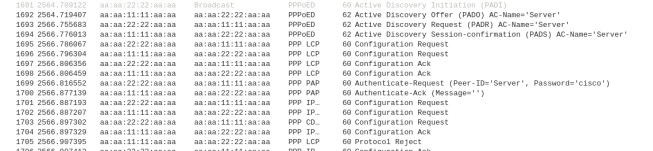
  1. PPPoED Active Discovery Initiation (PADI) – The PPPoE client sends a broadcast
  2. PPPoED Active Discovery Offer (PADO) – The PPPoE server reply with an session offer
  3. PPPoED Active Discovery Request (PADR) – The PPPoE client request to connect to session
  4. PPPoED Active Discovery Session-confirmation (PADS) – The PPPoE server confirms session connection

PPPoED Active Discovery Terminate (PADT) – the session is terminated  by client/server or due to configuration mismatch after it is shared between client and server.

The image below display a wireshark capture of the PPPoE session process mentioned above. Client MAC address contains 1111 and the Server contains 2222.
PPPoE_pcap

Configuring PPPoE Server

1. Configure the virtual template interfaces which allows server to set the configuration template for the each client virtual interface.

R(config)# interface virtual-template 1

R(config-if)# ip address [IP] [Mask]

!Configuring the MTU is necessary so that you don’t have packet fragmentation due to PPP use 2 Bytes and PPPoE uses 6 Bytes of the packet

R(config-if)# mtu 1492

!The peer command is optional if you want to assign an ip address to the clients from a static or DHCP pool

R(config-if)# peer default ip address [pool|dhcp|dhcp-pool] NAME

!The PPP Authentication is optional

R(config-if)# ppp authentication [pap|chap] callin

! After configuring the PAP/CHAP Authentication, you need to configure a username and password

R(config)# username [USER] password [PASSWORD]

2. Configure the Broadband Aggregation (BBA) Group which is used to spawn a virtual interface for each client that dials into the server and assign the virtual template.

R(config)# bba-group pppoe global
R(config-bba-group)#virtual-template 1

3. Configure the physical interface through which the clients will be connecting and assign it the bba group.

R(config)# interface [interface id]

R(config-if)#pppoe enable group global

R(config-if)# no shutdown

Configuring the PPPoE Client

1. Configure the interface Dialer

R(config)# interface Dialer 1

R(config-if)# encapsulation ppp

R(config-if)# ip address

R(config-if)#mtu 1492

R(config-if)#dialer pool 2

!Optional to configure authentication if server requires it

!PAP configuration to send username and password if needed by server

R(config-if ) ppp pap send-uername [USER] password [PASSWORD]

!CHAP configuration to send username(hostname) and password

R(config-f)ppp chap password [PASSWORD]

R(config-f)ppp chap hostname [USER]

2. Associate the physical interface with the dialer on which the PPPoE session will dial out.

R(config)# interface f0/0

R(config-if)# pppoe-client dial-pool-number 2

R(config-if)# no shutdown

Verify and Troubleshoot PPPoE

To verify pppoe is working, use the following commands:

1. Display the PPPoE session – show if the session is established

R# show pppoe session

2. Use debug to show PPPoE Events – displays PADI/PADO/PADR/PADR process

R#debug pppoe events

3. Use debug to show PPP negotiation – displays ppp configuration exchange

R#debug ppp negotiation

This is it for the PPPoE, I hope it helps in knowing how to configure PPPoE.

CCNP Route 300-101 – EIGRP

EIGRP routing protocol for IPv4 and IPv6

  • Default hello messages timer: 5 seconds
  • Default hold-down timer: 15 seconds
  • Multicast address: 224.0.0.10 (IPv4) / FF02::A (IPv6)
  • IP Protocol: 88
  • Administrative distance of 90
  • Autonomous Number is required to be the same with the neighbors.

Basic EIGRP Configuration

!IPv4 EIGRP configuration

R(config)# router eigrp [AS]

R(config)#network [subnet] [wildcard_mask]

!IPv6 EIGRP configuration

R(config)# ipv6 router eigrp 1
R(config-router) eigrp router-id [X.X.X.X]
R(config-router) no shutdown

!Configure command under participating interface in IPv6 EIGRP

R(config-if) ipv6 eigrp [AS]

EIGRP Metrics

To enable to metric for EIGRP, you use the following commands:

R(config-router)# metric weights 0 [K1] [K2] [K3] [K4] [K5]

Where the K values are:

  • K1 – Bandwidth [Kbit/sec] (default 1)
  • K2 –  Load (default 0)
  • K3 – Delay (default 1)
  • K4 and K5 – Reliability (default 0)

Calculating the full Metric (Formula)

Metric = ([K1 * bandwidth + (K2 * Bandwidth) / (256 – Load) + K3 * Delay] * [K5 / (Reliability + K4)]) * 256

Calculating the Default Metric

eigrp_metric_calculation

EIGRP Packets

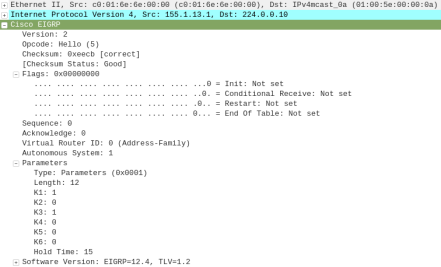
  • Hello (5)

eigrp_hello

  • Update (1)

eigrp_update

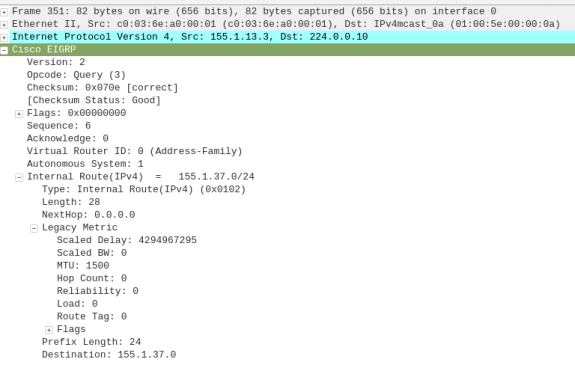
  • Query (3)

eigrp_query

  • Reply (4)

eigrp_reply

  • Ack (5)

eigrp_Hello_Ack

Administrative Distance (AD) – is how far is the router from it’s neighbor.

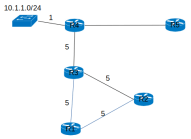
Feasible Distance (FD) – is how far is the router for the destination subnet.eigrp_diagram

  • R1 FD from 10.1.1.0/24 through R3
    • = (R1–>R3) + (R3–>R4) + (subnet 10.1.1.0/24)
    • = 5 + 5 + 1 = 11


Feasible successor – the advertised distance (AD) must be less than the feasible distance (FD) of the Successor (Feasible Successor AD < Successor FD)

EIGRP Neighborship

When the neighbor command is used, it forces the EIGRP to use unicast traffic to discover the neighbor.

R1(config-router)# neighbor [ip address]

The command and out display of the EIGRP neighbor:

show ip eigrp neighbors

show_eigrp_neighbor-cmd

As i continue my studies, this article will be updated.

CCNP Route 300-101 – ICMP Unreachable and Redirects

ICMP Destination Unreachable

The ICMP Destination Unreachable is a Type 3 message which is generated by the router to reflect device status being accessed.

ICMP Unreachable Type Code

0  – Network is unreachable

1 – Host is unreachable (telnet to unknown ip address on an existing interface)

2 – Protocol unreachable

3 – Port unreachable (use cisco trace route probe 1)

4 – Fragmentation need but DF set

5 – Source Routing

6 – 8 – unknown errors

9, 10, 13 – Admin Prohibited (telnet an interface with access-list filtering connection)

11, 12,14,15 – QoS, ToS, Precedence

ICMP Redirect

ICMP Redirect is a Type 5 message which routers use to advise source device of a better path.

ICMP Redirect Type Code:

  • 0 – Network
  • 1 – Host
  • 2 – Service & Network
  • 3 – Service & Host

I am covering these topics in my study preparation for CCNP and I will update this article as I go along.

CCNP Route 300-101 – RIPng

RIPng (RIP next generation) is the routing protocol RIP version for IPv6.

  • Default hello messages timer: 30 seconds
  • Default dead timer: 180 seconds
  • Multicast address: FF02::9
  • Communication Protocol: UDP 521
  • Administrative distance of 120
  • RIP name is not required to be the same with the neighbors.

Configure RIPng on a Router:

  1. Enable IPv6 routing in the global mode

ipv6 unicast-routing

2. Configure RIPng

IPv6 router rip [NAME]

3. Configure interface for IPv6

ipv6 address X:X:X:X::/64 [eui-64]

or

ipv6 enable 

4. Configure interface for RIPng

ipv6 rip [NAME[ enable

output for command: show ipv6 route rip

IPv6 Routing Table – 6 entries
Codes: C – Connected, L – Local, S – Static, R – RIP, B – BGP
U – Per-user Static route, M – MIPv6
I1 – ISIS L1, I2 – ISIS L2, IA – ISIS interarea, IS – ISIS summary
O – OSPF intra, OI – OSPF inter, OE1 – OSPF ext 1, OE2 – OSPF ext 2
ON1 – OSPF NSSA ext 1, ON2 – OSPF NSSA ext 2
D – EIGRP, EX – EIGRP external
R 2222::/64 [120/2]
via FE80::C202:46FF:FED7:0, FastEthernet0/0

output for command: show ipv6 rip

RIP process “WAN”, port 521, multicast-group FF02::9, pid 218
Administrative distance is 120. Maximum paths is 16
Updates every 30 seconds, expire after 180
Holddown lasts 0 seconds, garbage collect after 120
Split horizon is on; poison reverse is off
Default routes are not generated
Periodic updates 207, trigger updates 7
Interfaces:
FastEthernet0/1
FastEthernet0/0
Redistribution:
None

output for command: show ipv6 protocol 

IPv6 Routing Protocol is “rip WAN”
Interfaces:
FastEthernet0/1
FastEthernet0/0
Redistribution:
None

output for command: show ipv6 rip next-hops

RIP process “WAN”, Next Hops
FE80::C202:46FF:FED7:0/FastEthernet0/0 [2 paths]

This article will be updated as I go along.

CCNP Route 300-101 – Unicast Reverse Path Forwarding (uRPF)

Unicast Reverse Path Forwarding (uRPF) is a feature that allows the router to block unknown source IP address or spoofed IP address on an incoming interface. uRPF uses Cisco Express Forwarding (CEF) FIB to perform its function which means only CEF capable devices are supported.

uRPF has two modes:

  • Strict mode – uRPF only check source ip address of packets on configured interface.
  • Loose mode – uRPF check source ip address of packets on any interface. This mode is preferred for networks that has multiple up-links or interface.

Strict mode configuration

R1(config-if)# ip verify unicast source reachable-via rx [access-list]

The RX parameter determines the strict mode in the command

Loose mode configuration

R1(config-if)# ip verify unicast source reachable-via any [access-list]

The Any parameter determines the loose mode in the command

uRPF verification

You can verify the blocking of spoofed ip address by using the following command:

show ip interface [interface #] | section IP verify

The verification drops shows the number of drop spoofed source packets on the interface as seen in the image below.uRPF

R2 spoofed IP address 1.2.2.2 is trying to reach destination ip address 3.3.3.3 but it is blocked by R1 using uRPF. You can see R1 show command displays 5 verification drops.

You can also create an access-list to log any deny packets and assigned it to the uRPF using the following command:

! Create Extended Access-list

R1(config)# access-list 100 deny ip any any log

! Under the interface assigned access-list to the uRPF

R1(config-if)# ip verify unicast source reachable-via rx 100

for the same example of R1, the uRPF packet drop will be shown by the access list 100 log as seen below:

uRPF_accesslist-log

I hope this article helps to understand the use uRPF. 

CCNP Route 300-101 – Cisco Express Forwarding (CEF)

The Cisco Express Forwarding (CEF) is a Topology-Based switching technology. It is enabled by default on most cisco router and layer 3 switches.

device(config)# ip cef

The CEF is made up of two tables:

  • Forwarding Information Base (FIB)
  • Adjacency table

Forwarding Information Base (FIB) table – maintains next-hop Layer 3 address information based on the information in the IP routing table. CEF use the FIB to make IP destination prefix-based switching decisions. The command to show FIB below:

show ip cef

Adjacency Table – maintains Layer 2 next-hop addresses for all FIB entries. If the information is not available, ARP is used to discover this information. The command to show adjacency table below:

show adjacency

Type of Adjacency That requires Special Handling

  • Null – Packets destined for a Null0 interface
  • Glean – used for directly connected routes. Tells router to check ARP table
  • Punt – used for packets that cant be forwarded by CEF. it is sent to next level switching method
  • Discard – packets discarded by access-list or other policy
  • Drop – packets cant forward because of encapsulation error or unsupported protocol.

CEF can be enabled in one of two modes:

  • Central CEF mode – When CEF mode is enabled, the CEF FIB and adjacency tables reside on the route processor, and the route processor performs the express forwarding. You can use CEF mode when line cards are not available for CEF switching, or when you need to use features not compatible with distributed CEF switching.
  • Distributed CEF (dCEF) mode – When dCEF is enabled, line cards maintain identical copies of the FIB and adjacency tables. The line cards can perform the express forwarding by themselves, relieving the main processor – Gigabit Route Processor (GRP) – of involvement in the switching operation. This is the only switching method available on the Cisco 12000 Series Router.

Packets that CEF cannot handle:

  • IP Header Option
  • Expiring TTL
  • Tunnel interface
  • Exceed MTU
  • IGMP Redirect


Reference:

https://www.cisco.com/c/en/us/support/docs/routers/12000-series-routers/47321-ciscoef.html#cef-ops

https://www.cisco.com/c/en/us/td/docs/ios-xml/ios/ipswitch_cef/configuration/15-mt/isw-cef-15-mt-book/isw-cef-overview.html?referring_site=RE&pos=1&page=https://www.cisco.com/c/en/us/support/docs/routers/12000-series-routers/47321-ciscoef.html#GUID-993D4B0C-C032-420D-8304-F56AAB1CECC6


VMware VCP 6.7-DCV – Objective 1.10 – Describe virtual machine (VM) file structure

The following notes will assist you to prepare for this objective:

  • You need to know the files that make up a VM and what they do
    • VMX, VMDK, VSWP, VMSD, VMSN, etc
  • You need to know their behaviour
    • What gets created if missing?
    • What is naming convention of files?
    • What is the snapshot naming behaviour?
    • Any differences between VMFS5 and VMFS6?
    • How do resources reservation affects files?
  • You should also be familiar with virtual disk types
  • Try in your home lab to create VMs with
    • Thin provisioned disk
    • Thick provisioned disk
    • Eager zero thick provisioned disk
    • Could you convert from one disk type to another? How exactly?
  • Get to a vSphere host command line and look at what gets created
    • Nothin like doing to lock this into your memory!

Reference: vSphere ESXi vCenter-Server 67 Virtual Machine Admin Guide pdf

VMware VCP 6.7-DCV – Objective 1.6 – Describe and differentiate among vSphere, HA, DRS, and SDRS functionality

The following notes will assist you to prepare for this objective:

  • HA has come a long way, don’t rely on legacy knowledge of HA to meet objective
  • Learn the newer features, pre-reqs and limitations of:
    • Proactive HA
    • Orchestrated Restart
    • Fault Tolerance (FT) vSMP
  • HA can’t work around everything
    • For example datastore connectivity loss or unable to satisfy reservation
  • Ensure you can explain the basic modes of DRS
    • Disable, Manual, Partial, Full Automated, per-VM
  • DRS has come a long way
    • Predictive DRS
    • Limitations of vMotion have been overcome
  • What are the vMotion pre-reqs?
    • CPU compatibility
    • Network configuration
    • Compatible virtual hardware
  • What virtual hardware options can and cannot be migrated with DRS?
  • SDRS often gets overlooked
    • Remember it has 2 dimensions to optimization
      • Space utilization & I/O latency
      • What are you being asked in the question?

Reference: 

vSphere Availability Guide pdf

vSphere Resource Guide pdf

Brian Graf Blog – https://www.brianjgraf.com/2016/10/17/vsphere-6-5-vsphere-ha-whats-new-part-3-orchestrated-restart/

VMware VCP 6.7-DCV – Objective 1.5 – Manage vCenter inventory efficiently

The following notes will assist you to prepare for this objective:

  • What is efficient?
    • Think about vCenter inventory hierarchy and its organization
    • Parents/children/siblings
  • What constructs do you have available to you to organize objects?
    • Datacenter object
    • Cluster object
    • Folder object
    • Resource pool
    • vApp
  • Be aware of dependency
    • Can you create a cluster before a datacenter?
    • Can you put a datacenter in a folder?
    • Try these simple operations in your test lab
  • Are there any constraints on inventory object creation?
    • Resource pools and vApps have scope
  • Can you scale beyond a vCenter?

Reference:

vCenter Server and Host Management Guide pdf – chapter 8 – Organizing the inventory